"All that once lived, here ever lives," said a Pelledrine poet of Dinotopia's enduring vitality of creatures and cultures. Sealed off from the rest of the world by a circle of storm-lashed reefs, the island hosts a wide array of dinosaurs, whose ancient wisdom has inspired the diverse humans shipwrecked on its shores over the millennia.
A viewer atop the Tentpole of the Sky, a Tibetan citadel on the central high peak of the Forbidden Mountains, can survey rain-soaked jungles to the west, sparse plains to the north, and dry canyons to the east, all fringed with a rugged shoreline averaging 100 miles distant.
This Noah's Ark menagerie of Mesozoic life broke away from the Asian subcontinent and was carried into isolation by continental drift.
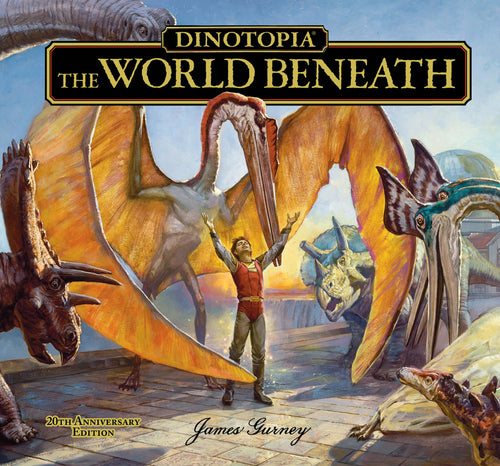
The dinosaurs survived the killing clouds from the meteor impact 65 million years ago by seeking shelter in the vast caverns of The World Beneath. During the Ice Ages, a land bridge invited mammoths, giant ground sloths, and other mammals to spread to the island's uplands, which were inhospitable to the saurians.
Nearly 6,000 years ago, when human beings first arrived, the stage was set for one of the most remarkable civilizations on Earth to begin its glorious ascent.
"Heavy seas, typhoons all day, breakers all around," gasped the logbook of the galleon Margaret before she struck and sank on Dark Coral Point in 1641. She is one of over 450 shipwrecks known to litter the coastline of Dinotopia since the first Abyssinian reed boats, Polynesian catamarans, and Mesopotamian quffas began venturing into its waters.
Ships' logbooks frequently refer to the appearance of dolphins near Dinotopia, some say beckoning the ships toward—other say warning them away from—impending doom. But the survivors of the wrecks agree on one point: that the dolphins took great care to lift them to the surface and guide them safely to shore. Shipwrecked immigrants are called "dolphinbacks"; the first group was lost on a spice voyage in 3874 BC.
Few have succeeded in escaping the island's treacherous ring of reefs, except for the Chinese sailor Qui Nong, who managed to thread his improvised junk through the Whirlpool Straits—one of the only exits—and bring his tales of giant reptiles to his people, who spun them into a rich dragon lore.
Salvaged ships provide the building material for villages like Bilgewater, Stufanto, and Dinglecreek. In Neopylos, the main street is arched with figureheads. Black Fish Tavern harbors a tough crew of treasure hunters who scour the sea floor in submersibles. The richest region for shipwrecks lies beneath Dolphin Bay, where Spanish galleons in search of El Dorado were lost in 1572. But today these royal wrecks are well-guarded by bone-plated giant fish like Dunkleosteus.
Humans speak a lingua franca known only to the island, a blend of the many languages spoken by newcomers. Some words have a Greek or Latin base, as does cumspiritik (literally "breathing together"), the Dinotopian word for marriage or close friendship. A common salutation is "Breathe deep, seek peace."
Dinosaurs have languages of their own, often unintelligible to humans. The large sauropods express their states of feeling through upward and downward gliding sounds, which can be reproduced by humans with thumb pianos and xylophones. Hadrosaurs perform music with their human counterparts, who have fashioned instruments to mimic the haunting sounds.
The Protoceratops multilinguous, a hog-sized dinosaur with a beak like a parrot's, is able to make the sounds of human speech and has undertaken the role of translator and ambassador for humans.
Even before the first humans arrived, dinosaurs heard reports from the dolphins about the existence of a bipedal race of creatures with a tolerable level of intelligence and, most interesting of all, a dextrous hand with an opposable thumb. The first people brought with them a remarkable knowledge of architecture and agriculture, along with other habits like warfare, which took time to unlearn. A peaceful interdependence has developed over the centuries. Just as the dinosaurs appreciate the skills and liveliness of Homo sapiens, the humans benefit from the wisdom and gentleness of the ancient beings who have successfully survived on earth for well over 100 million years.
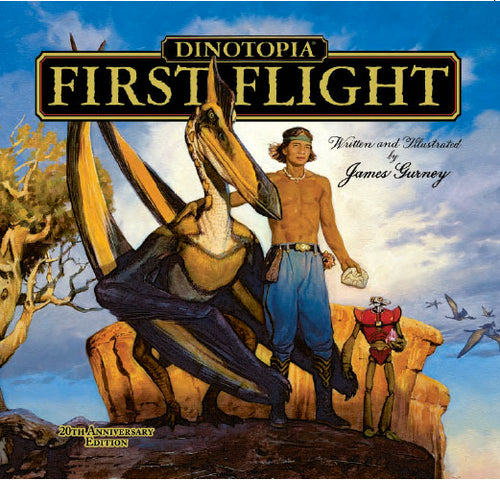
In their early teens, humans may choose to become apprenticed to a dinosaur partner; together they study a particular habitat of the island, such as freshwater swamps, arid deserts, or rain forests. Most prestigious of all are the skybax riders, who fly on the back of the gigantic Quetzalcoatlus to survey the island from the air.
Not all dinosaurs participate in this harmonious exchange. The large meat-eaters like Tyrannosaurus rex live solitary lives in the Rainy Basin. They are "hungry by nature, with no love for society and no stomach for green food." Travel through their territory requires an armored caravan. Even then, vigilance, cunning, and an offering of smoked eels or shark meat is the price of safe passage.
Elaborate masks of fierce tyrannosaurs adorn the festivals of pod villages like Bonabba and Chimeerney, which lie near the terminus of the Cross-Basin Trail.
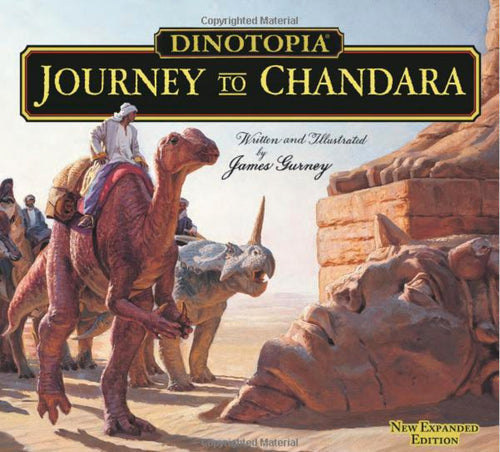
Chandara is the capital city of Dinotopia's southeastern quadrant, and the seat of an ancient empire of the same name. By the time of Arthur Denison's arrival in 1862, Chandara had fallen out of contact with the west. Leaders in Sauropolis, deploring Chandara's lack of a democratic round table, officially closed the Belt Road to trade caravans, thus dooming cities like Ruhmsburg that had thrived on the flow of goods. Desert guards on giant flightless birds called Diatrymas patrolled the western fringes of the empire to evict strangers.
The city's origins go back to 3855 BC, when it began as a fortified palisade on the promontory above the Zhengtao River. An era of monument building began a few centuries later, culminating in masterworks like the Temple of Ballakaloosh and the Dengahari Gates, designed by the saurian architect-scribe Djhuty, who escaped Dinotopia in 3107 and retired to Egypt, where he became known as "Thoth." Several times in Chandara's history, waves of invaders have tried to plunder its riches, but each group has been converted and absorbed by the magic of the city. A group of giant carnivorous warrior-monks lives in a monastery on Pungdok and Shaoling Islands.
Within its city limits, Chandara has Dinotopia's largest population of both humans and saurians, including many of the exotic feathered maniraptors like Caudipteryx and Microraptor. Concentric canals and broad avenues radiate like spokes around the central hub of the Imperial Palace. The exterior of this remarkable edifice is carved from white marble, while the interior is lavishly painted with mythological scenes and exotic forms of calligraphy. In this remote and lofty height lives the beloved and elusive emperor Hugo Khan.
Rushing, roaring, gurgling: The sound of water never completely escapes the hearing of a citizen of Waterfall City. Three broad canals are named after the marine reptiles who assist the tour boats and ferry visitors from the Mosasaur Harbor to outlying neighborhoods. A network of subterranean waterways built into the basement of the city once provided a sophisticated water taxi service on seashell gondolas, but it fell into disuse after some difficulty with cave-ins.
Hatchlings and toddlers frolic in the Wading Pool near the Booraza Café or splash in the spray of the waterworks on Fountain Avenue. Every evening the Aqua Stadium features a show performed by sea creatures and their riders, who often make spectacular entrances to the Water Arena on the Big-Snake Water Slide. Elaborate waterwheels in many households operate whimsical dishwashing mechanisms, designed more with the intent of impressing dinner guests than cleaning plates.
Even the city's slang has evolved along a watery course: a dull fellow is said to have "silted up"; an artist receiving inspiration has "hit the green geysers"; and a self-taught student has "filled his own basin."
Praised as the "jewel of the polongo," Waterfall City is Dinotopia's western center of learning and the arts, with ample provision for visiting students and masters. It is the home of the immense central library, whose scroll-shaped books are written in the ancient dinosaur footprint alphabet. Most writing is not even copied onto the scrolls, but rather jotted in sandboxes by high-stepping ornithomimid scribes.
In the midst of lighthearted homes of puppeteers and toymakers stands a sober temple that houses the Guest Registry, a scroll where newcomers record their names and special gifts. Students in training to become habitat partners study the Demisaurian Epics, larger-than-life tales of half-human, half-saurian heros. Deeds of the demisaurians adorn the Uzgol Tapestries, removed to Sauropolis in 1713 to protect them from mildew. Renowned musicians, from the great Oombajeeva stylist Gizelda Pepper to the Turfwallow Tubamen of Gammawamma, got their start at the informal Musicians' Inn on Steep Street, and later performed under Cornelius Mazurka in Ruhmsburg. Though the Toy Museum contains several working phonographs from as early as 1654, the inhabitants of Waterfall City have little use for recorded music, instead enjoying live performances from a harper's barge or a dragon horn boat. At the Concert Hall alongside the Mosasaur Harbor, the seats and stage can be lowered below the level of the water, where visible through thick glass windows, plesiosaur ballets accompany specially composed aquatic suites.
Human and saurian dancers from all across Dinotopia practice their art in a spacious palazzo overlooking Pliosaur Canal. So lively are the Jamborini Jigs that the ground-shaking vibrations kick up waves in the Hot Baths next door. Quieter pose dancing has evolved into a rich vocabulary of gestures performed by a human/saurian pair to express the many moods of nature.
At the end of the day, citizens may gather at the Dining Commons, where tables are set at three different levels above the floor—the highest at 25 feet—and where musical belching is encouraged as a compliment to the chef.
Gray heads gather at the Round Table Hall, where matters of official business are taken up for debate. Believing that the power of suggestion is more enduring than the force of law, members of the esteemed assembly often say that a fool can manage his own affairs better than a sage can manage the affairs of others. But the management of the city itself requires unending vigilance. The force of the water undercutting the limestone foundation layer leads to frequent collapses, most recently in 1744, when the well-known Blue Mist Ballroom slumped into Cloudbottom Gorge, fortunately without loss of life.
Busy with leisure and leisurely with business, inhabitants of Waterfall City plan industriously for the celebration of each new holiday. At the Lantern Festival on February 28, children and hatchlings are allowed to stay up past their nest-time to light a joyful array of candles with the help of their parents, while their uncles, aunts, and care-creatures serenade them from the streets below. On the Day of Deep Rivers, wood-carvers whittle toy boats to send down the Cargo Chute on a symbolic journey of return to the sea. To honor the inspirational muse on June 14, artists cover the promenades with intricate chalk murals and then invite the rain, to remind themselves that the idea, not the work, is to be cherished.
The Sun's Hatchday on September 20 brings a unique ordeal for teenagers initiated into the way of knowledge: a 24-hour-long journey into the Three-Dimensional Labyrinth beneath the Pyramid of the Sun before emerging again into the light of day.
Of all holidays, none surpasses the Water Festival, which celebrates life's debt to water. People, dinosaurs, and other land creatures dress in fish costumes and parade through the streets, ending with a plunge off the Old Bridge into Kronosaur Canal, where dolphins help them back to land.
Produced by the Bureau of Expeditions GLOBAL GEOGRAPHIC SOCIETY Jaspar Wogtwaddle, President And High Chairman Sauropolis, 2007 Design and Production: Bingo Gwipper Cartography: Almaron Dorsalplate Data Compilation: Enit Sickleclaw Fact-Checker: Inspector Myops Historical Advisor: Brokehorn Art and Text: Judd Fumbleton