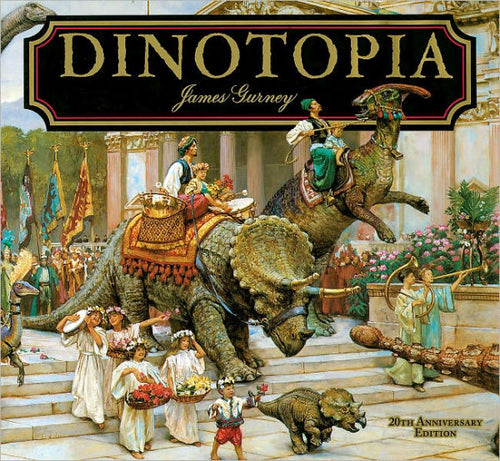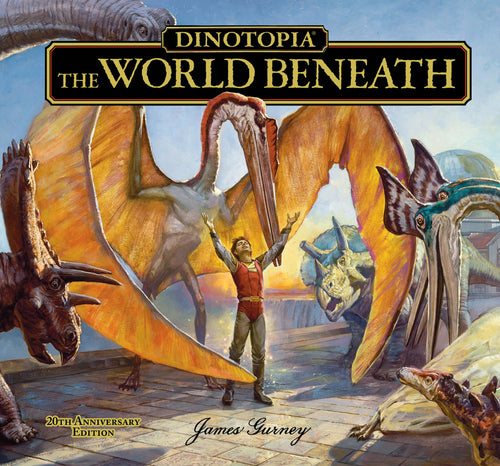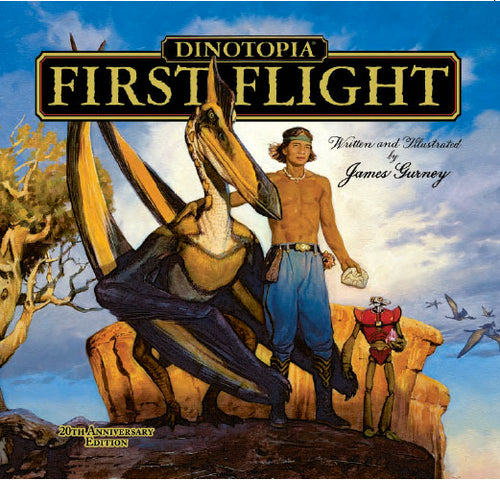
Not at all. All the books in the Dinotopia series are stand-alone sequels, which means you can enter the universe at any point. You don’t to have to know what happened before this book to fully enjoy it.
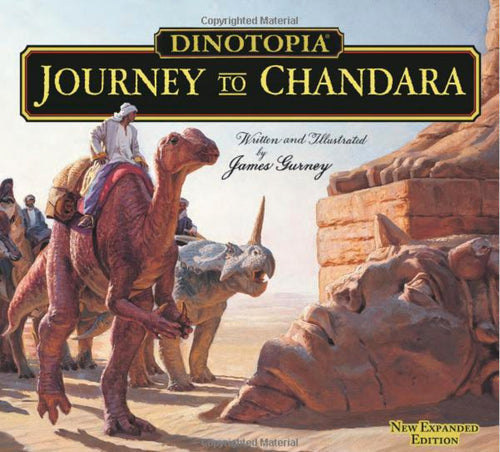
All the other Dinotopia books are currently out of print; only Journey to Chandara is available in bookstores at the present time. There are tentative plans to release beautiful new editions of the previous books, but that won't be for at least a year. Until then, you can still get new copies of the books by James Gurney from the Dinotopia.com Store.
I loved to draw since I was about seven years old. My favorite thing to draw was my chubby beagle named Susie. I liked making models of ships and airplanes even more than drawing. My parents didn't have time to encourage me much (I was the youngest of five), but I thought they were cool because they let me use the welder and the power tools in the workshop when I was still still in fifth grade. Don't worry—I still have all my fingers!
Our family had a set of the old adventure classics by Robert Louis Stevenson and Jules Verne, books like Treasure Island and 20,000 Leagues under the Sea. Once in a while my Dad would read aloud from them, and I would look forward to each of the glorious illustrations by N.C. Wyeth.
When I was about eight years old my parents took me to a science museum where I was a life-size skeleton of an Allosaurus. I was bowled over to see such a fantastic and scary-looking creature and to know it was real. I imagined that the creature would come to life at night, step off the platform and wander around the empty museum. I was also inspired by a series of dinosaur illustrations by Z. Burian that looked as real as photos to me, and it really made me want to learn how to make paintings look real.
I went first to UC Berkeley and majored in archaeology, a subject I that always fascinated me. I then went to school for a couple of semesters at Art Center College of Design in Pasadena, where I learned some very helpful material about perspective. However, most of what I have learned has been self taught. After Art Center, I developed my own curriculum of self-teaching based on The Famous Artist's Course from the 1950's, Andrew Loomis's book Creative Illustration, and the teaching methods from the 19th Century French Academy, which involved fairly detailed anatomy and cast drawing. All this academic work was combined with daily outdoor sketching, which became such a passion that I ended up coauthoring a book on the subject for Watson-Guptill called The Artist's Guide to Sketching in 1982.
Norman Rockwell was my childhood hero, so I was thrilled that the NR Museum hosted a Dinotopia exhibit from Feb. 18-May 20 2006. I also always loved MC Escher. Both artists really succeed in pulling viewers into their work. I also greatly admire the Dutch book illustrator Rien Poortvliet. Other artists I admire: Frederic Church, William Bouguereau, Sir Lawrence Alma-Tadema, and Howard Pyle.
As I high school student, I learned how to do hand-lettered calligraphy, and made my first income from designing wedding invitations. I got a job doing engraved line illustrations for ring ads in the newspaper. I didn't really start in the business until I was about 20, when I started doing paperback covers for science fiction and fantasy books. I never used agents or sourcebooks, instead sending samples directly to art directors.
I sent them samples and went in for an interview. They didn't like the samples at first (because they were fantasy-related), but liked my attention to detail, and gave me a chance. They work with their illustrators on a freelance basis, though in the past they used to have artists on staff.
I traveled to Jerusalem, Athens, and Rome on assignment for National Geographic, and it was a huge inspiration to see those famous old cities. I spent time with Rick Bronson, an archaeologist who was just like Indiana Jones. He led me through overgrown jungles to find little known Etruscan ruins, and we descended down ladders into newly-discovered tombs. Sitting around the campfire at night, Dr. Bronson and I would talk about dreams of discovering a lost city like Machu Picchu or Troy. I realized that I could always make a painting of such a lost city, and that led to Dinosaur Parade and Waterfall City. After that, I drew a map of an unknown island and came up with the idea of a Victorian explorer who discovers this island and reports about it in his journal.
That part is easy. Ideas come from combining two different things together that don't seem to go together. For example, Waterfall City is a combination of Venice and Niagara Falls. Skybax riding is a combination of horseback riding with giant flying reptiles. Take two things that interest you and combine them. You'll come up with a million ideas.
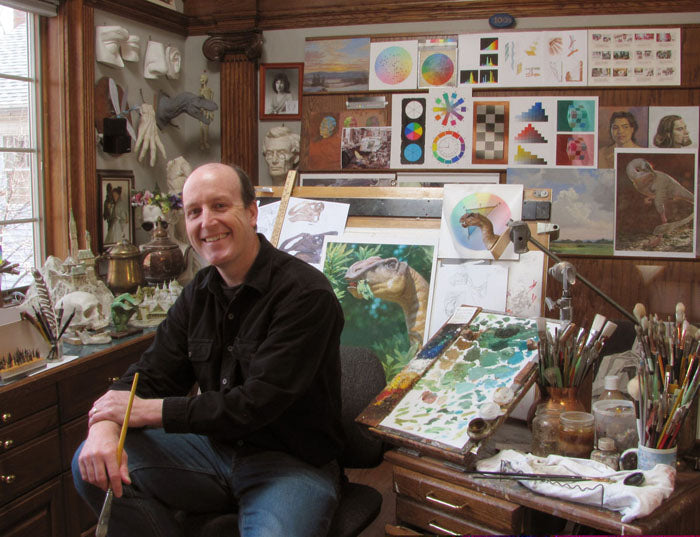
My studio is part of my house, right above the garage. There's a four-foot square skylight above the painting area, flanked by color-balanced fluorescents. The countertops are covered with dinosaur models and toy robots and the closets are full of costumes and props. I have a pet parakeet named Kooky who hangs out on a big playground right next to my painting area. My window looks out past a bird-and-butterfly garden to an oak forest, inhabited by pileated woodpeckers, a flock of wild turkeys, and families of foxes. I typically work from 8:30 to 5:30 five or six days a week, listening to classical music and books on tape as I paint and draw. I usually sit down when I paint indoors, but stand up when I paint studies outdoors from nature.
Some pictures only take a day. Most take a week. Big ones with lots of people take about a month. Most of the time is spent in the preparatory stages. Each Dinotopia book takes me about two and a half years to write and illustrate. All the pictures are painted in oil.
I start with small thumbnail sketches in marker or pencil, sometimes dozens. If it's an architectural subject or a dinosaur, I'll often build a little model or mockup to establish shadows and angles. If necessary I enlist models to pose in costume, usually friends or neighbors. I either take photos or do tone paper sketches of the models. I have a large mirror mounted in the studio and often develop tone paper studies of myself posing in costume to get the basic action. I also have a scrap file of color magazine photos that I use for texture and form ideas. If the painting requires scientific or historical accuracy, I consult with experts at every stage of the process and incorporate their suggestions. After all these studies, I work up the line drawing—and sometimes a full charcoal drawing—and finally begin the final painting.
Oil is my favorite, though I didn't begin using oil until my 20s. I often use oil in transparent washes over a line drawing that has been sealed with acrylic matte medium. I've been using just turpentine and Liquin for the painting. All the Dinotopia paintings are done in oil. I often work on heavy weight illustration board, and sometimes on oil-primed linen canvas.
In the early outlines and drafts, the book is all sketched out and outlined in longhand. That helps me think like Arthur Denison. In fact, I've been learning how to do the 19th Century Roundhand calligraphy with a dip pen in a style that was common in the 1860s. I use the computer for writing in the later stages when I need to fine-tune the text and get it to fit a given space on the page.
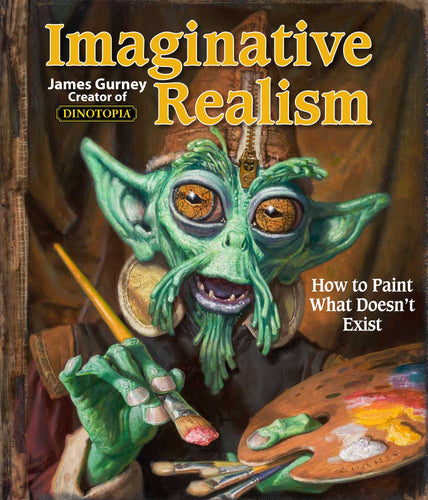
Some people have called this kind of work “imaginative realism” or “reality-based fantasy,” but I think it's really what artists have always done through history in portraying scenes from myth, literature, and the Bible. Basically what I'm trying to do is to create a realistic image of a scene that could never be photographed. My guiding philosophy is the old Latin saying “Ars est celare artem,” which means that true art conceals the artifice of its making. For me, creating depth and illusion is one of the most exciting goals of painting, but it's just a first step, because the higher goal is to select, accentuate, and subordinate all the elements of the picture to communicate a particular mood or feeling, and that goes beyond mere illusionism.
I find that the early stages of the painting, when the major areas are being established, are generally the hardest to get through. The reason is that the actual painting is very far from the original vision in my head. When this happens, I try to take one area to finish, and build from there.
I was shown the script, and I visited the set during filming, but I didn't have any real involvement with the production. It was the producer's idea to set the story in modern times and create all new characters. At first I resisted that idea, but in a way I'm glad they did it that way, because it keeps all my book characters fresh in my imagination without having to think about some actor's face instead. Also, Dinotopia is a big enough world with a long enough history that there are many, many stories that could be told about it. I have let a few authors write novels set in Dinotopia. In their case they were officially licensed and worked in close collaboration to keep the world consistent.
Yes, I encourage my readers to explore Dinotopia on their own and share their discoveries online with friends, but there are just three important ground rules. First, the work cannot be offered for sale in any way (or else it would have to be officially licensed); second, it must be presented as unofficial; and third, it shouldn't be shown to me (because I don't want to be influenced one way or another by someone else's ideas).
If you want to write or draw, start now. Learn everything you can about the world around you. Read lots of books. Keep a journal and a sketchbook. Believe in your dreams, because they will come true. And lastly, please keep in touch.
Everyone is born with an imagination; I believe the human mind is by its nature an image-making machine. But it takes training and practice to put the imagination to use artistically. One of the keys is to balance life sketching with drawings made from memory and imagination. At the early stages of the picturemaking process, it is vital to avoid relying too heavily on any singe piece of photo reference, and especially to avoid looking at other artists' work.
I've been lucky to receive thousands of letters from people all over the world, and I have responded to each one of them. I take encouragement from their kind words and constructive criticisms, but it doesn't affect the course of my writing or illustrating too much, except to remind me that my readers are very alert and intelligent, and that nothing is lost on them.